Professional Futures
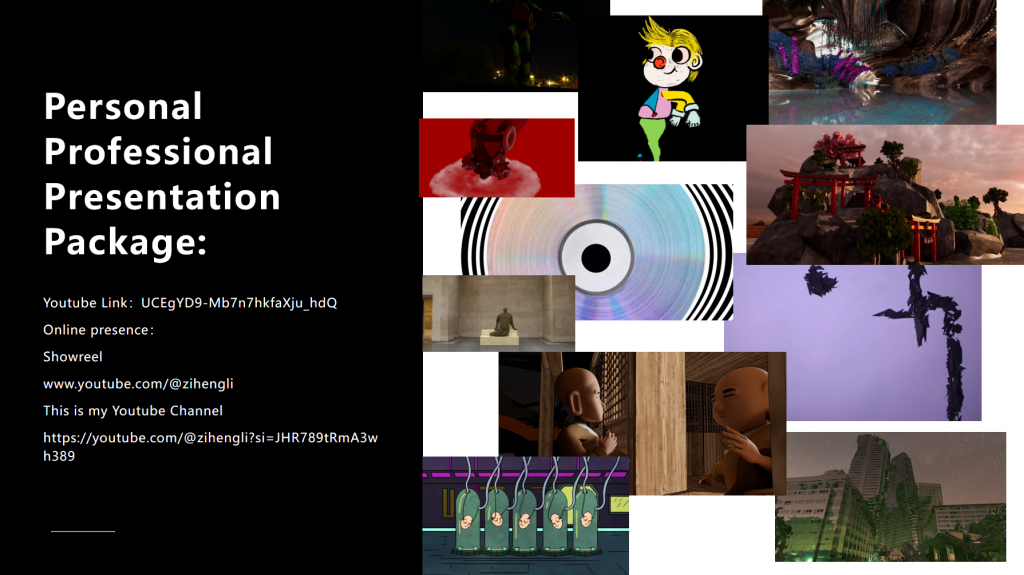
Personal Professional Presentation Package:
Youtube Link:UCEgYD9-Mb7n7hkfaXju_hdQ
Online presence:
Showreel
www.youtube.com/@zihengli
This is my Youtube Channel
https://youtube.com/@zihengli?si=JHR789tRmA3wh389
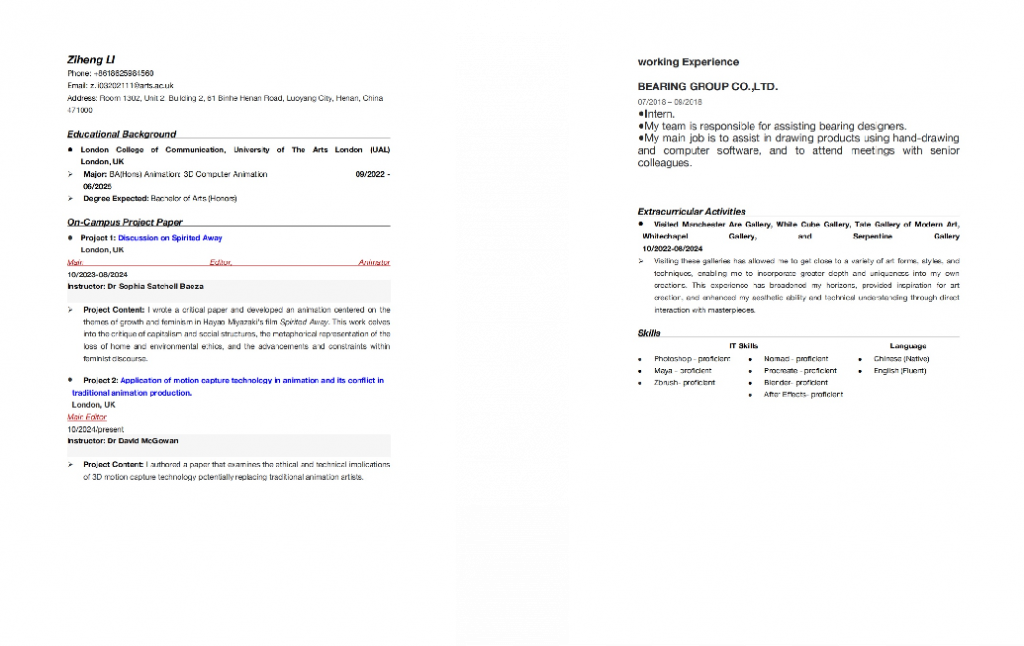
Covering letter
Dear Recruitment Officer:
Hello!
I am a recent graduate majoring in 3D Animation at London College of communicaton. It is my great honor to have the opportunity to submit my job application to your company.
In college period, I professionally learn the 3D modeling animation design Character Binding & Motion Capture Technique. Among them, I am good at animation creation, scene construction& terrain construction Proficiency in 3D software include Maya, Blender, ZBrush, Good knowledge of game engine Unity, Special effect software Nuke.Moreover, I’ve also contributed to the production of several individual animated short film and game projects, gained more practical experiences, cultivated a decent team working and communicative and coordinating ability.
Animation and games are always passionate to me since my childhood, and I always adore creation as a grown up. And I am keen to enrich my profession skill in creative and energetic team such as you, at the same time, contribute my creativity and enthusiasm. I expect that I could make good adaptation to you team under my professional foundation and learn ability, and could make value for your company.
Enclosed please find my portfolio and resume. I look forward to having the opportunity to further communicate with you and sincerely hope to obtain an interview opportunity.
Thank you for your attention and consideration!
Best
Salute!
Applicant:
Ziheng LI
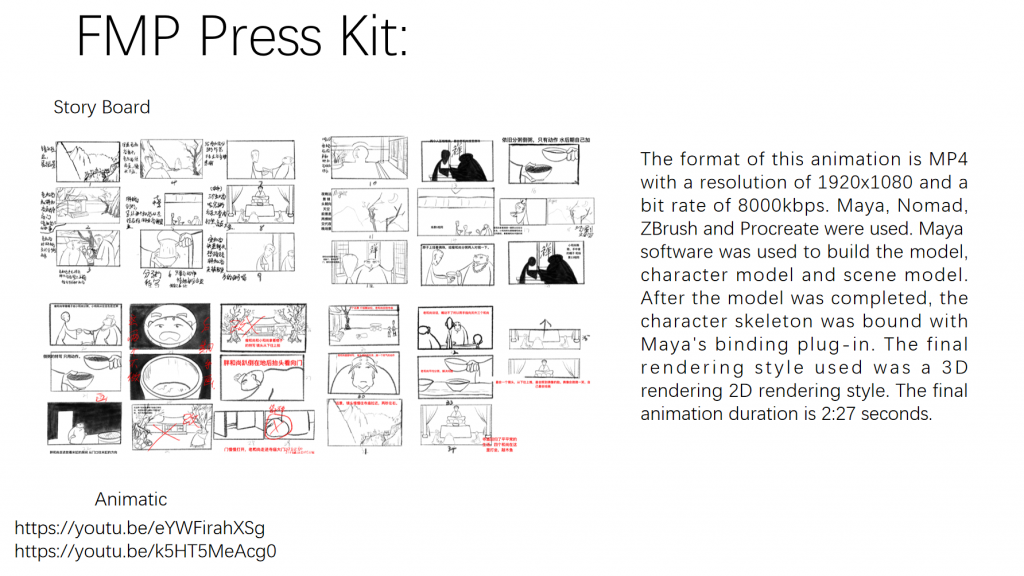
BA Hons Animation: FMP Monks share porridge
Project SynpsisSynopsis
A long time ago, there was a temple where a group of monks lived. Every day, they had a fixed pot of porridge to share with everyone. Among them, there was an old monk who was responsible for sharing the porridge. But one day, the old monk went down the mountain to do some work and gave the task of sharing the porridge to a fat monk in the temple. However, when other monks in the temple saw the old monk leave, they began to bribe the fat monk to get an extra portion of porridge. In the end, the unfairness became more and more serious until the old monk returned to the temple and the problem was solved.
Core Theme
The old monk is the balancer of power. When he is not around, other monks will do something to break the balance of the rules in the temple.
Target Audience
This would be more suitable for teenagers or adults than children, as the story can be used to explore philosophical issues such as the importance of power and supervision.
For the audience, it is visually appropriate for any age, but on a comprehension level it will focus on an older audience rather than children.
System determines fairness: Simple “free competition” or “equal distribution” does not necessarily bring true fairness, and reasonable system design is more important. In the process of benefit distribution, human instinct often leads to unfairness, so mechanisms need to be designed to prevent this from happening. I think this story will be used to discuss issues such as corporate management, resource allocation, and social fairness, reflecting the key role of the distribution system in maintaining fairness and efficiency.
character design
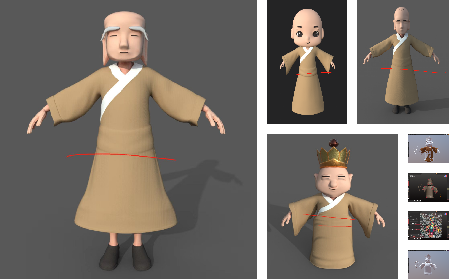
After importing the model into Nomad, split the UV and import the model into Procreate for hand-painted textures.
The character design of the initial version was very much in my own personal style, but it didn’t fit in with the overall style of the story and the modeling and clothing were not conducive to walking and doing certain actions, so this version was abandoned.
he column on the left is the final version of the character design, which matches the style of the work, cancels the exaggerated Gaza appearance of the fat monk, and makes the color of the character’s clothing more able to match the tone of the scene, so that it will not look so abrupt.
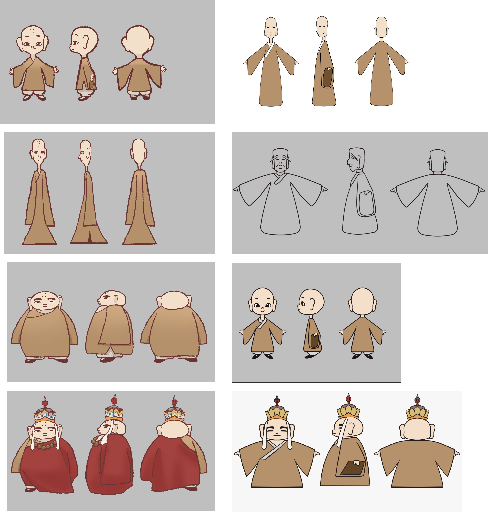
character design
The modeling style was inspired by hand-drawn sketches, but I wanted the final result to be in the style of toon shading, so I chose to hand-draw the facial features on the model’s face.
After importing the model into Nomad, split the UV and import the model into Procreate for hand-painted textures.
Terrain Design
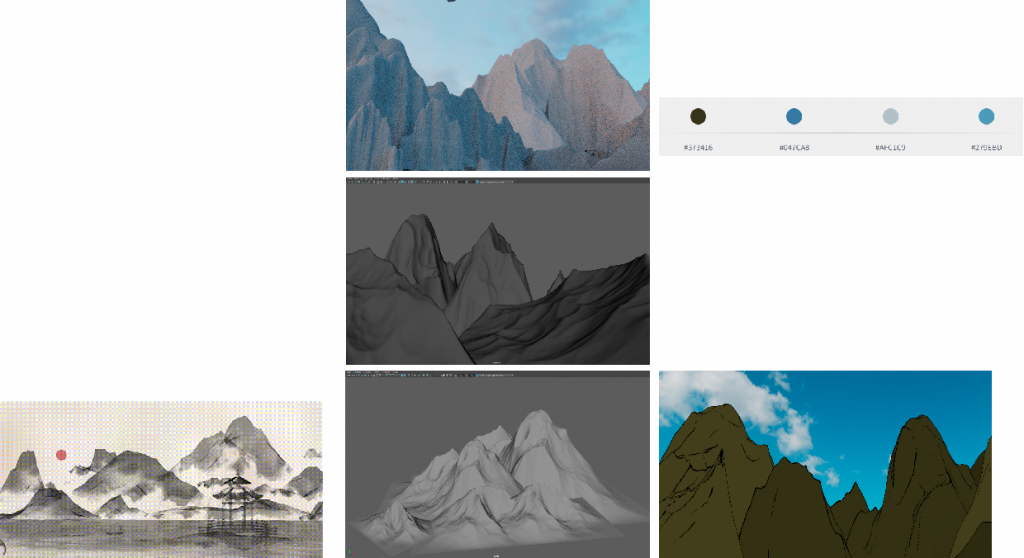
The original version was intended to be a mountain in the style of ink painting, but it was abandoned because the mask would become messy when the 3D version of the ink painting style was finally exported, and it could not present the ink painting style well.
Option 2 finally decided to use toon shading rendering method to determine the theme style of this project, and toon shading was completed using line strokes and ramps.
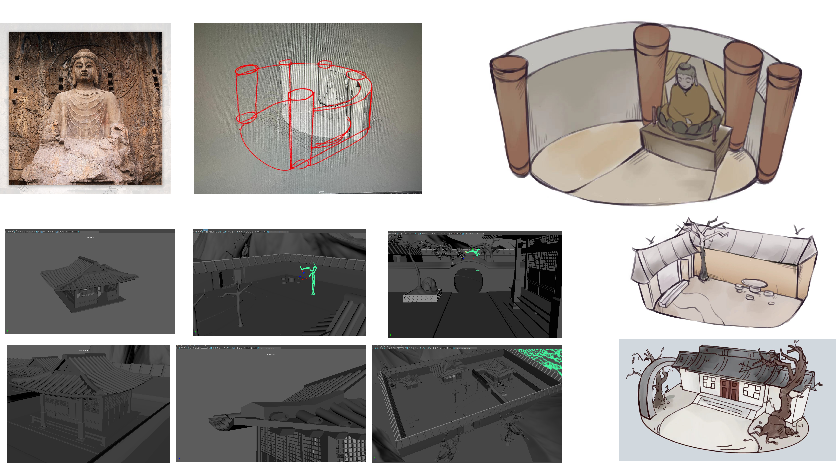
Many traditional oriental temple buildings are based on wooden frames and adopt a courtyard layout with a central axis symmetry. The most notable feature is the graceful curved hip roof or hip roof, with stacked brackets and flying eaves. The building complex is built on the mountain, with a wooden frame and bracket system, and also has the elastic structure of “the house will not collapse even if the wall collapses” and the modular characteristics of the column grid layout.
The Buddha statue in the temple lobby is modeled after the Vairocana Buddha at the Longmen Grottoes, a famous Buddhist attraction in my hometown.
The design of the roof is modeled after the roofs of ancient temples (bofeng boards). The roofs of these buildings extend out of the gables at both ends to prevent wind and snow. Wooden strips are nailed to the top of the purlins, which also serves to cover the beam head. This is the bofeng board. In the modeling, the cylindrical model of the roof restores the structure of the bofeng board.
Option 2 finally decided to use toon shading rendering method to determine the theme style of this project, and toon shading was completed using line strokes and ramps.
Animatic with sound
This soundtrack uses pure piano music, piano variations, and fast and slow rhythms to promote the development of the entire plot, the beginning, rise, climax, decline and ending of the story.
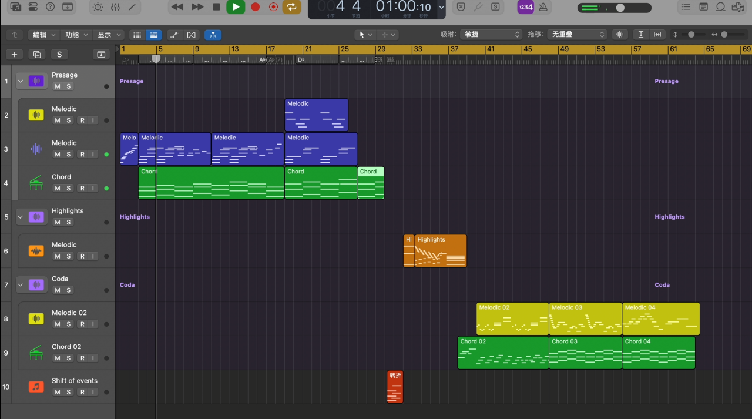
Sound Link:https://youtu.be/FbfwIjgUwh0
Animation
My way of making animation is to reference characters to make animations instead of importing character models into the scene to make animations, because importing means merging a file into the current file, that is, after saving and opening next time, the previously imported file also exists in the current file. It is simply adding a file.
Reference means displaying a file in the current file, and you cannot make any changes to the referenced file. After you save and open it next time, Maya will automatically read the path of the referenced file. If the path changes, it will report an error and you will not be able to see the previously referenced file in the file.
I think referencing animation is more efficient for a team to make an animation. This method is often used in division of labor production, you can browse the progress of others’ production at the same time, and you can also use its location as a reference. The file size is small and the content is more.
Because I have a lot of animation shots, I chose to do the animation first and then apply the textures.
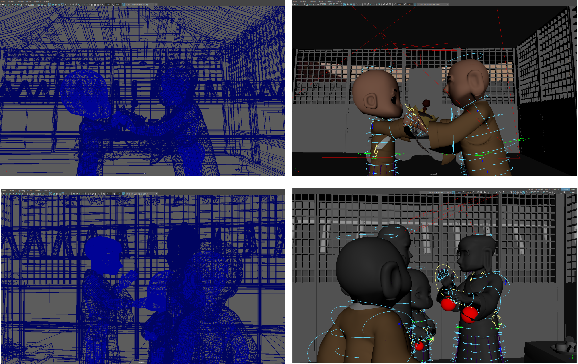
Render Shots
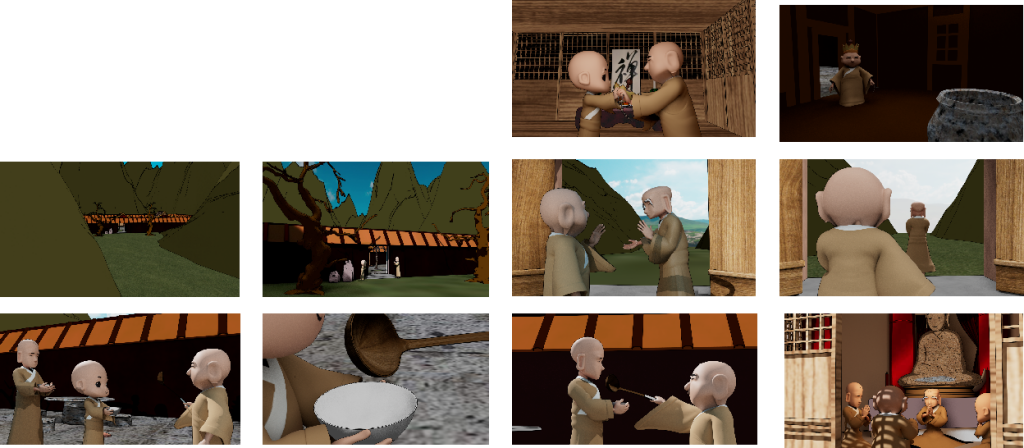
Employment and progression research
In one of the lectures every Friday, I learned about the importance of lighting, which inspired my strong interest in the position of lighting engineer in 3D animation. I think the position of lighting engineer is very important because lighting is the main means to express the core of the story clearly, and can affect the audience’s visual experience and emotions such as happiness and sadness. For example, you can use the three-point light source mentioned by the lecturer. The lecturer said that the three-point light source is divided into main light source, auxiliary light source and backlight source. The main light source is the most important in the picture. The characteristic is that it is used to reflect the three-dimensional sense of the picture at a 30-45 degree angle from the character or the main building. The auxiliary light source is used to create shadows. The function of the backlight source is to illuminate from behind the object and outline the general outline of the character. The three light sources complement each other and are the basic skills of a lighting engineer. After mastering them, you can create a more perfect visual effect.
Because the work of the lighting engineer is a relatively late part, it is usually necessary to cooperate with the animator, renderer and director. In many fields, such as the animation and game industries, high-level lighting engineers
In this FMP, I used three-point light sources to increase the look and feel of my animation. For example, in the scene where the fat monk distributes porridge to other monks, I used the main light source to make the models of the three monks look particularly three-dimensional when they were rendered. Although I used the toon shading method, the noise in the shadow part of the characters was reduced a lot with the help of auxiliary light sources and backlight sources. In the past year 2, the noise of the scene or the characters bothered me a lot, but in FMP, I used the three-point light source method to solve this problem that has troubled me for two years.
I want to apply for the position of lighting engineer at Electronic Arts in the future. I browsed the recruitment page of EA’s official website. It requires that those with 5 years of work experience are preferred. Regarding this, I need to work in the relevant industry as soon as possible. The skill requirements are that you need to master MAYA, UNREAL ENGINE, HOUDINI and other 3D and special effects software, but these software are the most important. You also need a portfolio to show your lighting design skills, art aesthetics and scene rendering capabilities. There are also certain requirements for teamwork and communication skills. I carefully studied the art style of EA, such as (FIFA, APEX, Battlefield series, because I particularly like their games, so I have played all of these games, and this time my FMP style also refers to these games and animation CG. The next step I need to do is to produce and accumulate experience, build a high-quality portfolio, especially realistic style and cartoon style (refer to Plants vs. Zombies-Homeland Defense, APEX), pay attention to recruitment information, and hope to stand out in future employment.
Professional Project Work Sub TV
Zhongrui Long & Ziheng Li
Storyboard
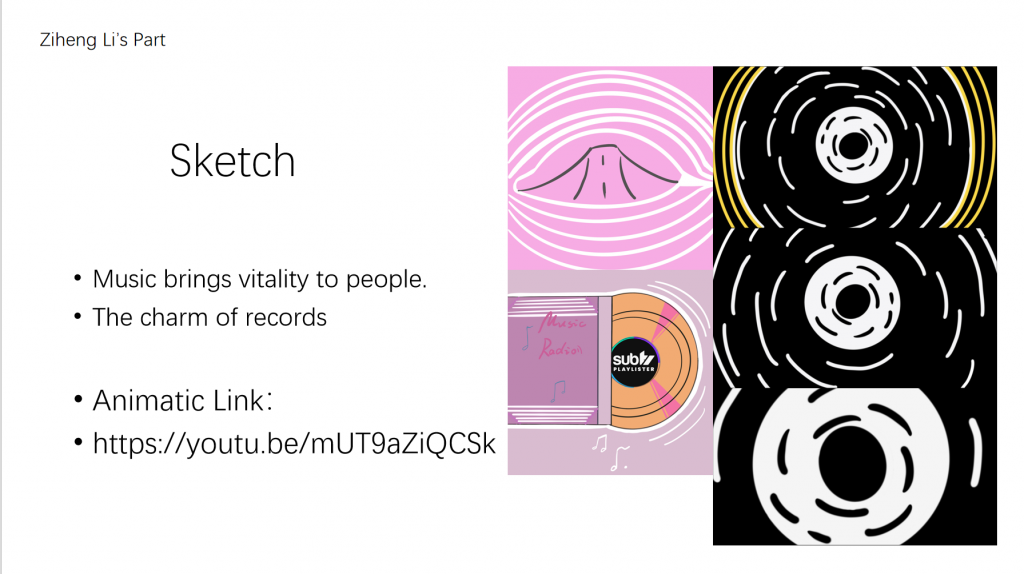
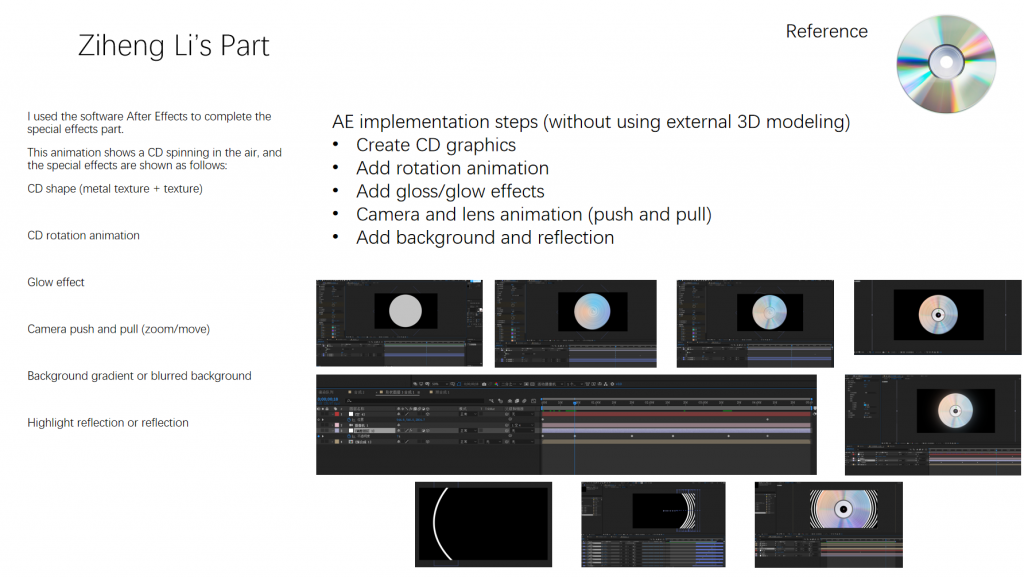
The story aims to depict how a record was caught in a claw machine, and after listening to This electronic music, it regained vitality like a bouncing musical note. In the end, it introduces this logo.
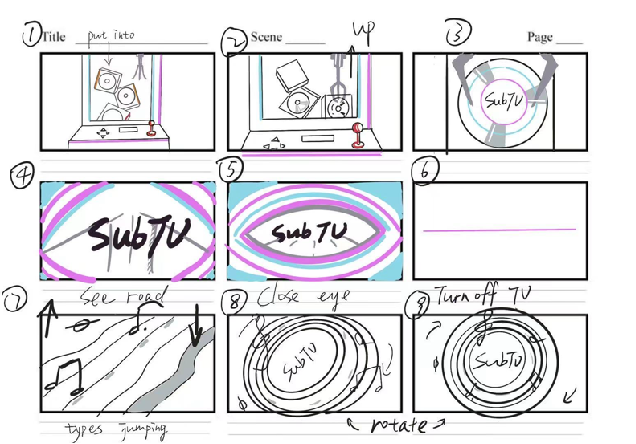
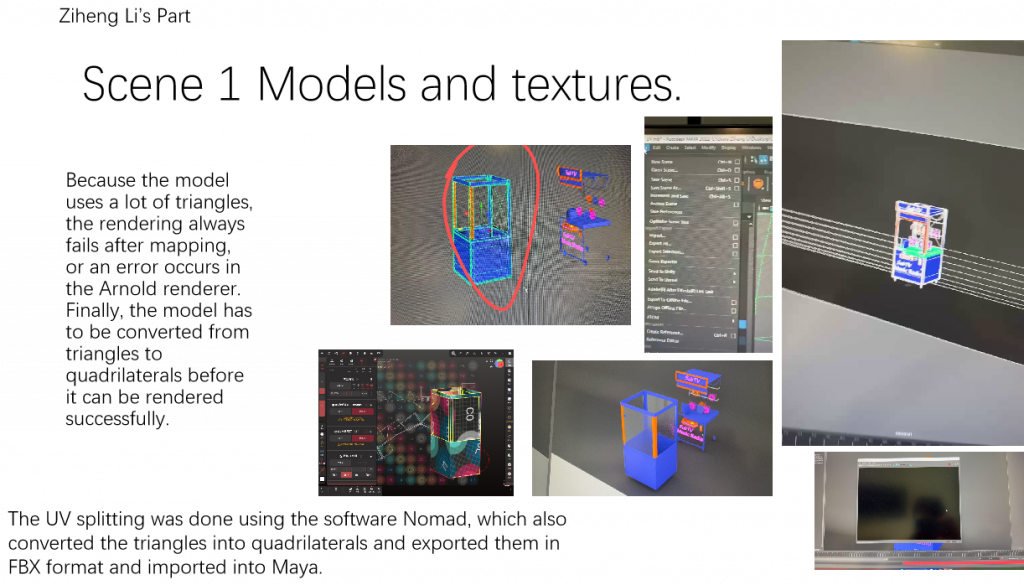
Scene1_claw machine
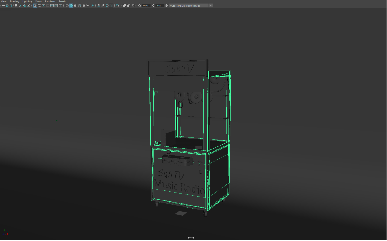
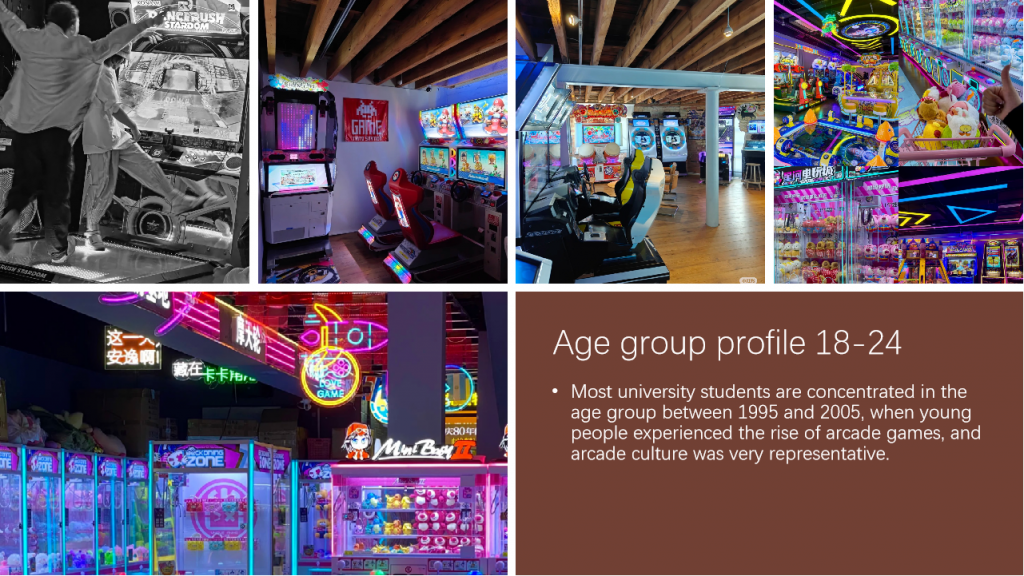
The reason for choosing the claw machine is that it best represents the arcade, as almost every arcade has one.
In arcade-style artistic creations, bright colors like blue and pink are also used to attract young people.
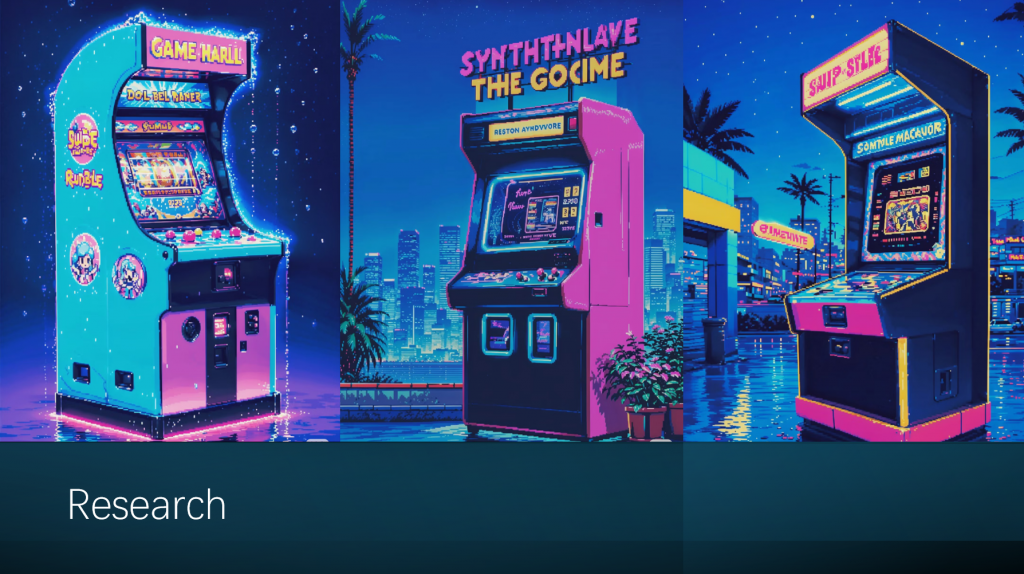
Scene 1 Models and textures.
Color palette
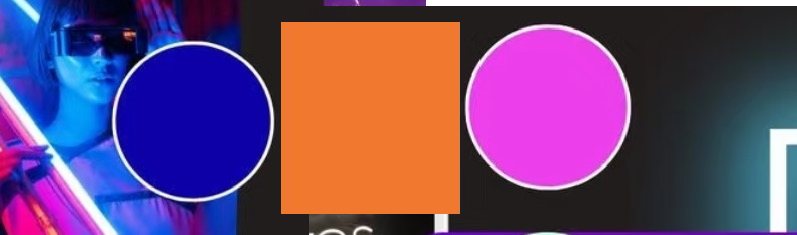
The reason why orange, blue and pink can give people a “retro” feeling is mainly due to their extensive use in popular culture, design styles and media in the mid-to-late 20th century (especially from the 1970s to the 1990s). This retro feeling is actually the restoration of the aesthetics of the times, the visual style, and the projection of the popular colors and emotional memories of the time.
Orange: Warm, nostalgic, sunny, retro home.
Blue: Technology, night, disco, cool contrast.
Pink: Dreamy, soft, retro fashion, youth.
When these three colors are used together, especially in certain combinations (such as neon gradients, geometric patterns, and grainy textures), it is easy to associate them with:
“Retro records, old TVs, dance hall lights, retro arcade games, old photos, flashing billboards…”
Final Outcome
Animatic
https://youtu.be/i_larx_Q2F4
Critical Appraisal
Through the study and practice of this unit, I have gained a deeper and more critical understanding of the 3D animation major, especially the direction of lighting design. This unit not only imparts basic knowledge, but also helps me clarify my future career interest direction through industry lectures and practical operations. Under the guidance of experts from multiple fields, especially the sharing of a senior speaker engaged in lighting design, I developed a strong interest in the profession of lighting designer.
The role of lighting design in 3D animation is far beyond my initial understanding. It is not merely used to “illuminate” the scene, but more importantly, to create an atmosphere, guide the audience’s attention and enhance the narrative’s appeal. When I first came into contact with Maya and Arnold for lighting and setting, I found it very difficult. Although three-point light sources are theoretically simple and easy to understand, in practice, I often make the picture appear stiff or lack layers due to unreasonable light intensity, incorrect direction setting or improper shadow handling. Especially when attempting to restore the real lighting effect, I deeply realized that there is still a huge gap between the understanding of optical principles and the ability to operate software.
Although this kind of setback was frustrating, it also prompted me to start systematically improving my technical ability. I spend time reading relevant books, watching professional tutorials, and repeatedly practicing the reasonable configuration of main light, auxiliary light and backlight. By adjusting parameters such as the exposure value, intensity, color temperature, and sampling number of Arnold lights, I gradually mastered how to use light to create an atmosphere, shape a sense of space, and enhance the expressiveness of characters. In the subsequent assignments, I successfully created a set of highly stylized night scenes, using the contrast of warm and cool tones to showcase the psychological states of the characters, and received positive feedback from the instructor.
However, when critically examining my own development process, I realized that the improvement of skills was only the first step, and I still needed to strengthen my artistic expression and aesthetic judgment. Lighting design is a discipline that integrates science and art. It requires not only precise control ability but also a strong sense of artistic sensitivity and visual narrative awareness. In many group projects, I found that my thinking was often limited during the conception stage, and I focused more on “completing the task” rather than proposing creative and expressive visual solutions. This exposes my shortcomings in creative divergence and interdisciplinary association.
To break through this bottleneck, I began to draw inspiration more actively from other fields such as photography, film and stage lighting. By analyzing the application of lighting in classic films, I have learned how to create dramatic conflicts through the contrast of light and dark and express the psychological states of characters through color Settings. Meanwhile, I also began to pay attention to the knowledge of visual psychology and color psychology, hoping to incorporate the potential emotional responses of the audience into the consideration of lighting design.
In terms of career development, this unit has helped me clarify my long-term goal, which is to become a lighting designer with creative influence in the game and animation industries. I pay special attention to globally leading game companies such as Electronic Arts (EA). By studying their recruitment standards, project styles and technical requirements, I realize the need to further master real-time rendering engines (such as Unreal Engine), physical-based rendering (PBR) processes, team collaboration processes and project management capabilities. Based on these requirements, I have formulated a clear phased improvement plan, including:Improve and update the personal lighting portfolio, covering cases of different styles and rendering engines;Sign up for online workshops and competitions related to CG to enhance practical experience.Take the initiative to contact lighting technicians in the industry, build a professional network through social media, and obtain feedback and suggestions;Learn bone binding and node systems to enhance technical adaptability in large-scale projects.In conclusion, the learning process of this unit is both a challenge and a transformation. From my initial superficial understanding of lighting, I gradually moved towards a comprehensive cognition of its artistry and technicality. Through the integrated efforts of reflection on setbacks, skills training and career planning, I have established a solid foundation on the path to becoming a professional lighting designer. In the future, I will continue to examine myself with a critical eye, constantly optimize my skill structure and creative expression ability, in the hope of securing a place in the rapidly developing digital entertainment industry.